


Digital Courses
Explore the essentials of IFS-Informed EMDR at your own pace with our digital courses! Perfect for those looking to dip their toes into this integrative approach, our online offerings combine flexibility with in-depth content, allowing you to engage in learning whenever and wherever it suits you.
Whether you are looking for a primer in the Syzygy Model™ or topic-specific courses to deepen your understanding, our growing course library is a resource for you and your learner parts!


Organic Interweave
Intended Audience
This is an intermediate level course for Mental Health Professionals with EMDR Basic Training and some foundational knowledge of the IFS Model
-
After completing this webinar participants will be able to:
Explain the relationship between Functional Dual Attention and Self-Presence.
Discuss the concept of energy as it applies to Protective Parts and how this can be measured and processed within EMDR.
Discuss the concept of energy as it applies to qualities of Self and how these can be measured and installed as a resource within EMDR.
Identify a third type of processing protectors with bilateral stimulation named after a stage of Coherence Therapy.
Explain what is meant by a Discovery Contract.
Discuss how hippocampal activation may support and enhance Functional Dual Attention.
Identify which three of the IFS 6F's correspond to eliciting Assessment Phase target elements.
Name the essential IFS feature that is verified in the Preparation Phase in order to proceed to Phase Three.
-
References
Anderson, F.G., Sweezy, M., & Schwartz, R.C. (2017). Internal family systems skills training manual: Trauma-informed treatment for anxiety, depression, PTSD & substance abuse. Eau Claire, Wisconsin: PESI Publishing. (LO1,2,8,11)Ecker, B., Ticic, R., & Hulley, L. (2012). Unlocking the Emotional Brain: Eliminating symptoms at their roots using memory reconsolidation. New York: Routledge. (LO7,9,10,13)
Ecker, B., Bridges, S.K. (2020) How the Science of Memory Reconsolidation Advances the Effectiveness and Unification of Psychotherapy. Clin Soc Work J 48, 287–300. https://doi.org/10.1007/s10615-020-00754-z (LO9,10,)
Hodgdon, H. B.; Anderson, F. G.; Southwell, E.; Hrubec, W.; Schwartz, R. C. (2022) Internal Family Systems (IFS) Therapy for Posttraumatic Stress Disorder (PTSD) among Survivors of Multiple Childhood Trauma: A Pilot Effectiveness Study. Journal of Aggression, Maltreatment & Trauma. Jan2022, Vol. 31 Issue 1, p22-43. 22p. 1 Diagram, 1 Chart, 1 Graph. DOI: 10.1080/10926771.2021.2013375. (LO1,2)
Gomez, A. M. & Krause, P. K. (2013). EMDR Therapy and the Use of Internal Family Systems Strategies with Children, In A. M. Gomez, (Ed.), EMDR Therapy and Adjunct Approaches with Children (pp. 299–345). New York, NY: Springer publishing. (LO1,2,5,6,12)
Knipe, J (2019) EMDR Toolbox: Theory and Treatment Methods for Complex PTSD and Dissociation. (Second Edition). Springer, New York. (LO3,7,9,13)
Kolodny,P. & Mazero, S. (2023). The interweave of Internal Family Systems, EMDR, and art therapy. In Davis, Elizabeth (Ed); Fitzgerald, Jocelyn (Ed); Jacobs, Sherri (Ed) & Marchand, Jennifer (Ed). (2023). EMDR and creative arts therapies. (pp. 208-240). New York, NY, US: Routledge (LO1,2,4,6)
O’Shea Brown, G. (2020) Internal Family Systems Informed Eye Movement Desensitization and Reprocessing: An Integrative Technique for Treatment of Complex Posttraumatic Stress Disorder, International Body Psychotherapy Journal, 19 (2). (LO1,2)
Popky, A.J. (2005) The De-tur Method. In R. Shapiro (Ed.), EMDR Solutions, New York: Norton. (LO3)
Schwartz, R.C. & Sweezy, M. (2020). Internal Family Systems Therapy (2nd ed.). New York NY: Guilford Press. (LO8,11,12)
Shapiro, F. (2018). Eye movement desensitization and reprocessing. Basic principles, protocols and procedures (3rd ed.) New York, NY: Guilford Press. (LO13)
Twombly, J. H., & Schwartz, R. C. (2008). The integration of internal family systems model and EMDR. In C. Forgash & M. Copeley (Eds.), Healing the heart of trauma and dissociation with EMDR and ego state therapy (pp. 295–311). New York, NY: Springer publishing. (LO1,4,5,6,12)
-
The American Psychological Association approves Syzygy Institute, LLC to sponsor continuing education for psychologists. Syzygy Institute, LLC maintains responsibility for this program and its content.
NBCC has approved Syzygy Institute, LLC as an Approved Continuing Education Provider, ACEP No. 7401. Programs that do not qualify for NBCC credit are clearly identified. Syzygy Institute, LLC is solely responsible for all aspects of the programs.
Syzygy Institute, LLC, provider #299, is approved to offer continuing education in social work by the Association of Social Work Boards (ASWB) Approved Continuing Education (ACE) program. Organizations, not individual courses, are approved as ACE providers. State and provincial regulatory boards have the final authority to determine whether an individual course may be accepted for continuing education credit. Syzygy Institute, LLC maintains responsibility for this course. ACE provider approval period: 08/12/2024- 08/12/2025.
NY Social Worker, Psychologist, MHC, & MFT approved.
EMDRIA approved.
IFS-Institute approved for recertification CE.
Our digital courses are not individually approved for ASWB. This impacts NJ and NY social workers.

How to Compose an IFS-Informed EMDR Assessment Phase
Intended Audience
This is an intermediate level course for Mental Health Professionals with EMDR Basic Training and some foundational knowledge of the IFS Model
-
How to Compose an IFS-Informed EMDR Assessment Phase is a two-hour recorded webinar presented by Bruce Hersey for psychologists, social workers, mental health counselors, and marriage & family therapists who have taken EMDR basic training.
It will describe using Internal Family Systems methods to engage the EMDR client in composing an IFS-informed EMDR Assessment Phase by maintaining an understanding that the target is a part, and dual attention requires Self-Presence. This results in the therapist engaging the Self of the client, which in turn gathers part-specific target elements from the part.
The webinar includes PowerPoint slide lecture with Q & A, discussion, & several interactive demonstrations of the process with participants from live workshops. Fidelity to both methods is maintained as course material is developed from standard EMDR (Shapiro, 2018) & IFS (Schwartz & Sweezy, 2020; Anderson et al., 2017) background texts with supplemental references, and the instructor is an IFS Approved Clinical Consultant, an EMDRIA Approved Consultant and has completed a Coherence Therapy Intensive Intermediate training.
Internal Family Systems therapy (IFS) is an evidence based (Hodgdon et al., 2022) ego state therapy which offers unique qualities that match key components of the EMDR’s foundational Adaptive Information Processing (AIP) model.
IFS methods have been utilized in the context of EMDR therapy to enhance therapist-client communication about their internal experience and trouble-shoot processing difficulties (Gomez & Krause, 2013).
Both IFS and EMDR have been described as experiential psychotherapies which can facilitate a form of neuroplasticity called memory reconsolidation, which uniquely unlocks and rewrites implicit memories that underlie many of the symptoms treated with these methodologies (Ecker et al., 2012).
Some concepts and language from Coherence Therapy supports and clarifies key IFS concepts around exploring positive (adaptive) intentions behind symptoms with curiosity, compassion & persistence (i.e., Self-presence), while also mirroring the requisite dual attention condition for EMDR processing.
These additional conceptual tools enable the IFS-informed EMDR therapist to more consistently generate juxtapositions (a critical condition required for memory reconsolidation), beginning in the Assessment Phase of EMDR and continuing through the subsequent phases of the EMDR Standard Protocol (Ecker & Bridges, 2020; Ecker et al., 2012).
Just as the SUD scale in conventional EMDR is used to measure state-binding affect energy (Seigel, 2022; Shapiro, 2019), urges, rather than affect, bind the disturbed state in the case of protective parts (Knipe, 2019; Popky, 2005).
A comprehensive scale to assess activation of defenses and target protective parts for processing, the Level of Urge to Protect (LUP) scale, which subsumes the Popky and Knipe scales, is introduced.
Additional precision in targeting underlying implicit memories, through application of memory reconsolidation research via Coherence Therapy, can increase the accuracy of identifying and elaborating appropriate positive and negative cognitions in the Assessment Phase.
A protector’s Negative Cognition can reveal an underlying Protector Positive Intention (PPI) (Ecker, 2012; Schwartz & Sweezy, 2020), which is more useful in targeting these parts for EMDR processing (Knipe, 2019).
The overlay of an IFS perspective via an IFS-informed Assessment Phase advances the widely understood consciousness attributed to the target of EMDR processing as ego states by consolidating the separate notions of an adaptive network and adult ego state into a single coherent relational consciousness which relates to the target from its own adaptive, compassionate perspective (the Self) and embodies the inherent healing capacity of a person known in both EMDR & IFS.
Learn to use the Presence of Self (POS) scale, as an additional tool to measure the engagement and integration of the adaptive information network and assure functional dual attention (similar to the VOC scale), beginning in phase two (Kolodny & Mazero, 2023).
-
List which Assessment Phase target elements are part-specific.
List which Assessment Phase target elements are dependent upon Self-presence.
Explain what is meant by Level of Urge to Protect.
Identify the two components of a Protector Positive Intention.
Explain what is accomplished by the ‘Feel-toward’ question.
Describe the use of the Presence of Self (POS) scale.
Explain the relational aspect of Functional Dual Attention.
Identify which 4 of the IFS 6F’s are relevant in the EMDR Assessment Phase.
-
References – Home Study Course How to Compose an IFS-Informed EMDR Assessment Phase - 2.0 CE
Anderson, F.G., Sweezy, M., & Schwartz, R.C. (2017). Internal family systems skills training manual: Trauma-informed treatment for anxiety, depression, PTSD & substance abuse. Eau Claire, Wisconsin: PESI Publishing. (LO5,7)
Ecker, B., Ticic, R., & Hulley, L. (2012). Unlocking the Emotional Brain: Eliminating symptoms at their roots using memory reconsolidation. New York: Routledge. (LO4)
Ecker, B., Bridges, S.K. How the Science of Memory Reconsolidation Advances the Effectiveness and Unification of Psychotherapy. Clin Soc Work J 48, 287–300 (2020). https://doi.org/10.1007/s10615-020-00754-z (LO4)
Gomez, A. M. & Krause, P. K. (2013). EMDR Therapy and the Use of Internal Family Systems Strategies with Children, In A. M. Gomez, (Ed.), EMDR Therapy and Adjunct Approaches with Children (pp. 299–345). New York, NY: Springer publishing. (LO1,2,7)
Hodgdon, H. B.; Anderson, F. G.; Southwell, E.; Hrubec, W.; Schwartz, R. C. (2022) Internal Family Systems (IFS) Therapy for Posttraumatic Stress Disorder (PTSD) among Survivors of Multiple Childhood Trauma: A Pilot Effectiveness Study. Journal of Aggression, Maltreatment & Trauma. Jan2022, Vol. 31 Issue 1, p22-43. 22p. 1 Diagram, 1 Chart, 1 Graph. DOI: 10.1080/10926771.2021.2013375. (LO1,7)
Knipe, J (2019) EMDR Toolbox: Theory and Treatment Methods for Complex PTSD and Dissociation. (Second Edition). Springer, New York. (LO3)
Kolodny,P. & Mazero, S. (2023). The interweave of Internal Family Systems, EMDR, and art therapy. In Davis, Elizabeth (Ed); Fitzgerald, Jocelyn (Ed); Jacobs, Sherri (Ed) & Marchand, Jennifer (Ed). (2023). EMDR and creative arts therapies. (pp. 208-240). New York, NY, US: Routledge (LO6,7,8)
Popky, A.J. (2005) The De-tur Method. In R. Shapiro (Ed.), EMDR Solutions, New York: Norton. (LO3)
Schwartz, R.C. & Sweezy, M. (2020). Internal Family Systems Therapy (2nd ed.). New York NY: Guilford Press. (LO5)
Seubert, A. (2018) Becoming Known: A Relational Model Utilizing Gestalt and Ego State-Assisted EMDR in Treating Eating Disorders. Journal of EMDR Practice & Research. 2018, Vol. 12 Issue 2, p71-85. 15p. DOI: 10.1891/1933-3196.12.2.71. (LO7)
Shapiro, F. (2018). Eye movement desensitization and reprocessing. Basic principles, protocols and procedures (3rd ed.) New York, NY: Guilford Press. (LO2)
-
The American Psychological Association approves Syzygy Institute, LLC to sponsor continuing education for psychologists. Syzygy Institute, LLC maintains responsibility for this program and its content.
NBCC has approved Syzygy Institute, LLC as an Approved Continuing Education Provider, ACEP No. 7401. Programs that do not qualify for NBCC credit are clearly identified. Syzygy Institute, LLC is solely responsible for all aspects of the programs.
Syzygy Institute, LLC, provider #299, is approved to offer continuing education in social work by the Association of Social Work Boards (ASWB) Approved Continuing Education (ACE) program. Organizations, not individual courses, are approved as ACE providers. State and provincial regulatory boards have the final authority to determine whether an individual course may be accepted for continuing education credit. Syzygy Institute, LLC maintains responsibility for this course. ACE provider approval period: 08/12/2024- 08/12/2025.
NY Social Worker, Psychologist, MHC, & MFT approved.
EMDRIA approved.
IFS-Institute approved for recertification CE.
Our digital courses are not individually approved for ASWB. This impacts NJ and NY social workers.
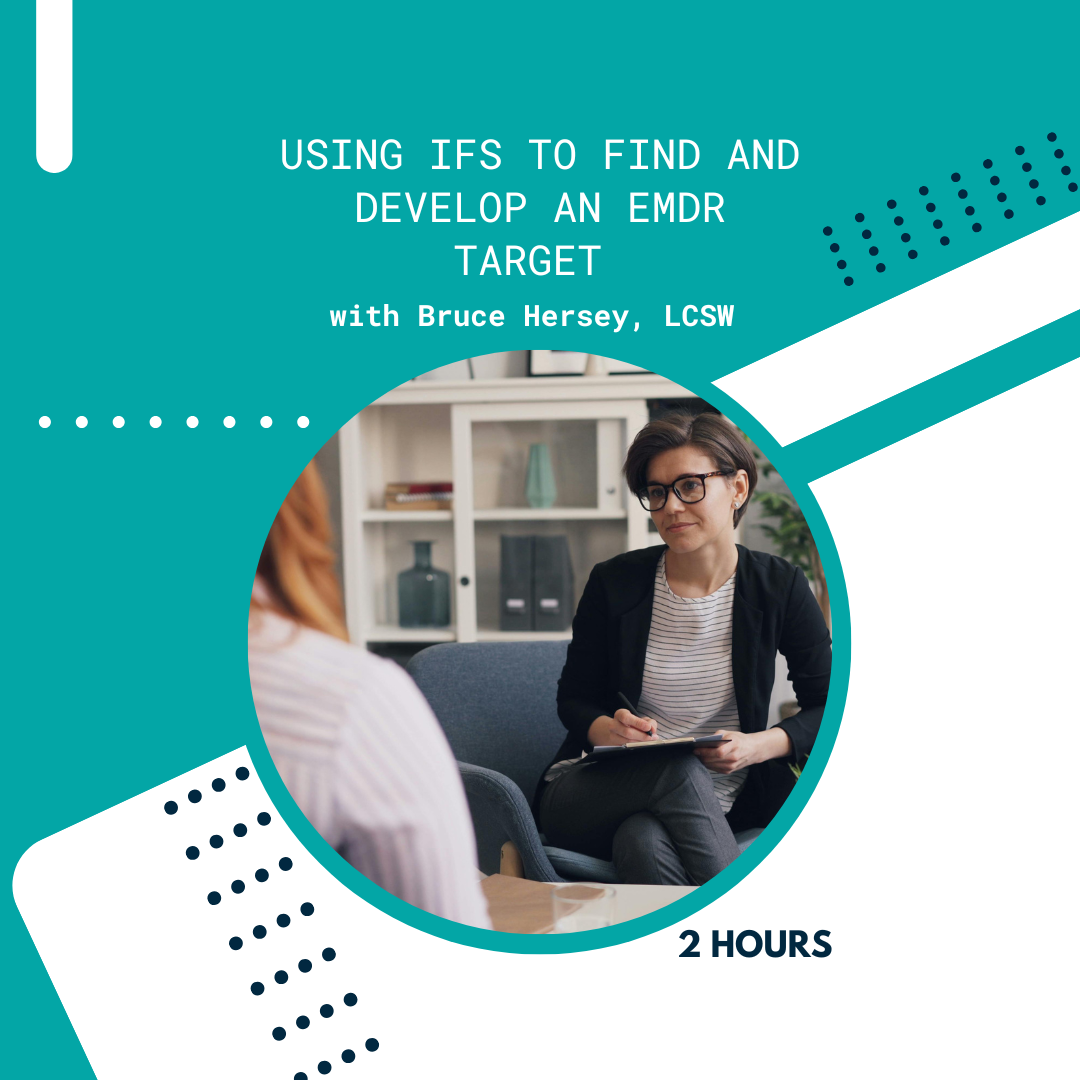
Using IFS to Find and Develop an EMDR Target
Intended Audience
This is an intermediate level course for Mental Health Professionals with EMDR Basic Training and some foundational knowledge of the IFS Model
-
Using IFS to Find & Develop an EMDR Target is a two-hour recorded webinar presented by Bruce Hersey for psychologists, social workers, mental health counselors, and marriage & family therapists who have taken EMDR basic training.
It will describe using Internal Family Systems methods to engage the EMDR client in Phases One and Two to identify possible targets for EMDR processing and focus in on the most appropriate immediate target. How different types of parts are organized can inform navigation in these phases.
Bruce shows how IFS helps determine whether there is enough Self-Presence for trauma processing, or whether there are blended parts to sort and select for IFS-Informed targeting in the preparation Phase.
The webinar includes PowerPoint slide lecture with Q & A, discussion, & several interactive demonstrations of the process with participants from live workshops. Fidelity to both methods is maintained as course material is developed from standard EMDR (Shapiro, 2018) & IFS (Schwartz & Sweezy, 2020; Anderson et al., 2017) background texts with supplemental references, and the instructor is an IFS Approved Clinical Consultant, an EMDRIA Approved Consultant and has completed a Coherence Therapy Intensive Intermediate training.
Internal Family Systems therapy (IFS) is an evidence based (Hodgdon et al., 2022) ego state therapy which offers unique qualities that match key components of the EMDR’s foundational Adaptive Information Processing (AIP) model.
IFS methods have been utilized in the context of EMDR therapy to enhance therapist-client communication about their internal experience and trouble-shoot processing difficulties (Gomez & Krause, 2013).
Both IFS and EMDR have been described as experiential psychotherapies which can facilitate a form of neuroplasticity called memory reconsolidation, which uniquely unlocks and rewrites implicit memories that underlie many of the symptoms treated with these methodologies (Ecker et al., 2012).
Some concepts and language from Coherence Therapy support and clarify key IFS concepts around exploring positive (adaptive) intentions behind symptoms with curiosity, compassion & persistence (i.e., Self-presence), while also mirroring the requisite dual attention condition for EMDR processing.
These additional conceptual tools enable the IFS-informed EMDR therapist to more consistently generate juxtapositions (a critical condition required for memory reconsolidation), beginning in the Assessment Phase of EMDR and continuing through the subsequent phases of the EMDR Standard Protocol (Ecker & Bridges, 2020; Ecker et al., 2012).
Just as the SUD scale in conventional EMDR is used to measure state-binding affect energy (Seigel, 2022; Shapiro, 2019), urges, rather than affect, bind the disturbed state in the case of protective parts (Knipe, 2019; Popky, 2005).
A comprehensive scale to assess activation of defenses and target protective parts for processing — the Level of Urge to Protect (LUP) scale — which subsumes the Popky and Knipe scales, is introduced.
Additional precision in targeting underlying implicit memories, through application of memory reconsolidation research via Coherence Therapy, can increase the accuracy of identifying and elaborating appropriate positive and negative cognitions in the Assessment Phase.
A protector’s Negative Cognition can reveal an underlying Protector Positive Intention (PPI) (Ecker, 2012; Schwartz & Sweezy, 2020), which is more useful in targeting these parts for EMDR processing (Knipe, 2019).
The overlay of an IFS perspective via an IFS-informed Assessment Phase advances the widely understood consciousness attributed to the target of EMDR processing as ego states by consolidating the separate notions of an adaptive network and adult ego state into a single coherent relational consciousness which relates to the target from its own adaptive, compassionate perspective (the Self) and embodies the inherent healing capacity of a person known in both EMDR & IFS.
Learn to use the Presence of Self (POS) scale, as an additional tool to measure the engagement and integration of the adaptive information network and assure functional dual attention (similar to the VOC scale), beginning in phase two (Kolodny & Mazero, 2023).
-
Identify one essential IFS task of EMDR Phase One.
List two essential IFS tasks of EMDR Phase Two.
Describe two human qualities IFS would attribute to the adaptive and target networks.
Describe a form of ‘Negative Cognition’ that applies to Protector Parts.
Explain what is meant by Biggest Part in the Room.
List the two types of energy that maintain the parts in their burdened state.
Identify the two conscious relational entities involved in Functional Dual Attention.
Explain the difference between how IFS-Informed EMDR defines the target v. conventional EMDR.
-
References – Home Study Course Using IFS to Find & Develop an EMDR Target - 2.0 CE
Ecker, B., Ticic, R., & Hulley, L. (2012). Unlocking the Emotional Brain: Eliminating symptoms at their roots using memory reconsolidation. New York: Routledge. (LO4)
Ecker, B., Bridges, S.K. (2020) How the Science of Memory Reconsolidation Advances the Effectiveness and Unification of Psychotherapy. Clin Soc Work J 48, 287–300. https://doi.org/10.1007/s10615-020-00754-z (LO4)
Gomez, A. M. & Krause, P. K. (2013). EMDR Therapy and the Use of Internal Family Systems Strategies with Children, In A. M. Gomez, (Ed.), EMDR Therapy and Adjunct Approaches with Children (pp. 299–345). New York, NY: Springer publishing. (LO1,2,4,5,7,8)
Knipe, J (2019) EMDR Toolbox: Theory and Treatment Methods for Complex PTSD and Dissociation. (Second Edition). Springer, New York. (LO4,6)
O’Shea Brown, G. (2020) Internal Family Systems Informed Eye Movement Desensitization and Reprocessing: An Integrative Technique for Treatment of Complex Posttraumatic Stress Disorder, International Body Psychotherapy Journal, 19 (2). (LO1,2,3)
Popky, A.J. (2005) The De-tur Method. In R. Shapiro (Ed.), EMDR Solutions, New York: Norton. (LO4,6)
Siegel, D. J. (2020). The developing mind: How relationships and the brain interact to shape who we are (3rd ed.). The Guilford Press. (LO6)
Schwartz, R.C. & Sweezy, M. (2020). Internal Family Systems Therapy (2nd ed.). New York NY: Guilford Press. (LO5)
Shapiro, F. (2018). Eye movement desensitization and reprocessing. Basic principles, protocols and procedures (3rd ed.) New York, NY: Guilford Press. (LO6)
Twombly, J. H., & Schwartz, R. C. (2008). The integration of internal family systems model and EMDR. In C. Forgash & M. Copeley (Eds.), Healing the heart of trauma and dissociation with EMDR and ego state therapy (pp. 295–311). New York, NY: Springer publishing. (LO1,2,3,5,7,8)
van der Hart, O., Groenendijk, M., Gonzalez, A. Mosquera, D., Solomon, R. (2014). Dissociation of the Personality and EMDR Therapy in Complex Trauma-Related Disorders: Applications in Phases 2 and 3 Treatment Journal of EMDR Practice and Research, Volume 8, Number 1, 2014. http://dx.doi.org/10.1891/1933-3196.8.1.33 (LO3,7)
Watkins, J.G., & Watkins, H. (1997) Ego States: Theory and Therapy. New York: Norton. (LO6)
-
The American Psychological Association approves Syzygy Institute, LLC to sponsor continuing education for psychologists. Syzygy Institute, LLC maintains responsibility for this program and its content.
NBCC has approved Syzygy Institute, LLC as an Approved Continuing Education Provider, ACEP No. 7401. Programs that do not qualify for NBCC credit are clearly identified. Syzygy Institute, LLC is solely responsible for all aspects of the programs.
Syzygy Institute, LLC, provider #299, is approved to offer continuing education in social work by the Association of Social Work Boards (ASWB) Approved Continuing Education (ACE) program. Organizations, not individual courses, are approved as ACE providers. State and provincial regulatory boards have the final authority to determine whether an individual course may be accepted for continuing education credit. Syzygy Institute, LLC maintains responsibility for this course. ACE provider approval period: 08/12/2024- 08/12/2025.
NY Social Worker, Psychologist, MHC, & MFT approved.
EMDRIA approved.
IFS-Institute approved for recertification CE.
Our digital courses are not individually approved for ASWB. This impacts NJ and NY social workers.
Digital Course Pre-Requisites:
EMDR Basic Training is required for all digital courses. We also strongly recommend prior foundational knowledge of the IFS model to support your learning experience.
Our digital courses are designed as supplemental education and do not replace our full IFS-Informed EMDR Training Program, nor do they count toward Syzygy Institute™ Certification.
They do qualify for Syzygy Institute™ recertification credit.

All content is evidence-based, and there is no commercial support or conflicts of interest for these programs or presenters.
You will retain access to all course materials for the lifetime of the program, with no expiration as long as the course remains available.
3 Course Bundle
3 Course Bundle

Save when you purchase the three-course bundle for $150.
This bundle includes all three IFS-Informed EMDR home study courses in the recommended order:
Using IFS to Find & Develop an EMDR Target
How to Compose an IFS-Informed EMDR Assessment Phase
The Organic Interweave: IFS-Informed EMDR
Continuing Education Information for Digital Courses:
The American Psychological Association approves Syzygy Institute, LLC to sponsor continuing education for psychologists. Syzygy Institute, LLC maintains responsibility for this program and its content.
NBCC has approved Syzygy Institute, LLC as an Approved Continuing Education Provider, ACEP No. 7401. Programs that do not qualify for NBCC credit are clearly identified. Syzygy Institute, LLC is solely responsible for all aspects of the programs.
Syzygy Institute, LLC, provider #299, is approved to offer continuing education in social work by the Association of Social Work Boards (ASWB) Approved Continuing Education (ACE) program. Organizations, not individual courses, are approved as ACE providers. State and provincial regulatory boards have the final authority to determine whether an individual course may be accepted for continuing education credit. Syzygy Institute, LLC maintains responsibility for this course. ACE provider approval period: 8/12/2025 - 8/12/2028.
NY Social Worker, Psychologist, MHC, & MFT approved.
EMDRIA approved.
IFS-Institute approved for recertification CE.
Our digital courses are not individually approved for ASWB. This impacts NJ and NY social workers.


More Information
-
These workshops are delivered in a manner that is in compliance with the Americans Disabilities Act.
Please contact hello@syzygyinstitute.com if special accommodation is required.
-
No cancellations or refunds. Six month access to recordings of live workshops and digital courses is available.
-
Please contact hello@syzygyinstitute.com, or call (856) 617-4544 ext. 7 with any questions or concerns regarding your purchase.
-
All grievances must be in writing to hello@syzygyinstitute.com, and will be replied to within 5 - 10 business days.
-
There is no conflict of interest or commercial support for these Syzygy CE programs or instructors.